
Mold Removal in Cartersville, GA
Mold needs three things: a food source, the right temperature and water. A north Georgia house has the first two all year. The third is the one we take away. Every mold job starts with finding out where the moisture came from, because a house that is still getting wet will grow mold again, no matter how clean we leave it.
Mold removal services
- Crawl space mold removalWet insulation and mold-damaged material removed, framing cleaned and the ground covered again.
- Mold after water damageMold that grew behind walls and under floors after a leak or a flood.
- Containment and HEPA air filtrationPlastic barriers and a negative air machine with a HEPA filter keep spores in the work zone.
- Porous material removalDrywall, carpet, padding and insulation with mold growing through them are taken out.
- HVAC and duct moldAir handler, plenum and ducts inspected, with wet flex duct and insulation replaced.
- Moisture source and dryingThe water source is found and the area dried, so the mold has no reason to return.
Musty smell in the house after a flood or a leak
A musty smell is usually the first sign. It is strongest in a closed room, near a floor vent or after the HVAC has been running. Look for the places water would hide: behind baseboards, under the bottom row of drywall, inside a closet on an exterior wall, in the carpet padding along a wall that got wet.
The EPA says wet materials need to be dried within 24 to 48 hours to stop mold growth. After that, the odds change. If a leak or a flood in your house is a few days old and nothing has been opened up yet, call now, not next week.
Source: EPA, A Brief Guide to Mold, Moisture and Your Home.
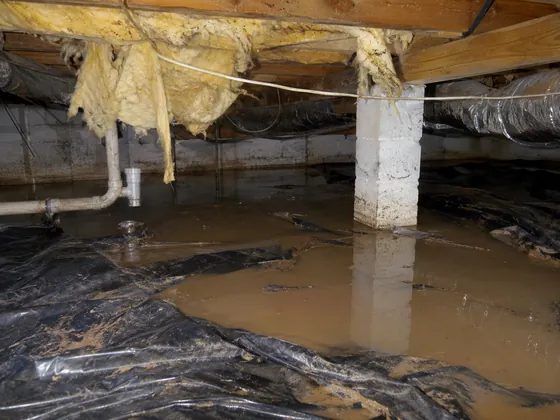
Mold in a crawl space in Georgia
Crawl space mold is the call we get most. A dirt floor with a torn vapor barrier lets ground moisture rise. Foundation vents let humid summer air in, and that air condenses on cool ductwork and pipes. Insulation falls down once it gets damp. Floor joists and the underside of the subfloor sit in damp air for months.
The fix has an order. Stop the water first: a downspout dumping at the foundation, a dripping drain line, a vapor barrier that has been pulled up. Then remove what cannot be saved, treat and clean the framing, and put the barrier back so the ground is covered. Whether a crawl space should be vented or sealed is an argument among builders. We deal with the water and tell you what we see.
Why bleach is not the answer to black mold
Bleach is the first thing most people reach for. It has two problems. On porous material like drywall and wood it does not reach the roots, and the water in the bleach feeds what is left. And it does nothing about the moisture.
The EPA says using a biocide such as chlorine bleach is not recommended as routine practice during mold cleanup, with an exception when someone in the house is immune-compromised. For hard surfaces, its advice is detergent, water and thorough drying. "Black mold" is a color, not a diagnosis. Mold in many colors can come from the same leak, and we treat all of it as a moisture problem.
Source: EPA, A Brief Guide to Mold, Moisture and Your Home.
Containment and HEPA air filtration
Disturbing mold throws spores into the air. Containment keeps them where we are working. We close off the area with plastic sheeting, run a negative air machine with a HEPA filter so air flows into the work zone and not out of it, and wear respirators and disposable suits. HEPA vacuums clean up afterward, and the debris is bagged before it leaves the room.
If you are living in the house during the job, we will tell you which rooms to stay out of and which doors to keep shut.
Removing versus cleaning porous materials
Hard, non-porous surfaces such as metal, glass, sealed tile and most framing lumber can be cleaned. Porous materials are another matter. The EPA says absorbent materials like ceiling tiles and carpet may have to be thrown away if they become moldy. Drywall with mold growing through the paper, soaked insulation and carpet padding come out.
Framing is the gray area. Solid wood with surface mold can often be cleaned and sanded. Wood that has gone soft is replaced. We show you what we find before we cut.
Mold in the HVAC and ductwork
If the system ran while the house was wet, or if a crawl space took water under the ductwork, mold can end up in the ducts, the air handler or the drip pan. A cold duct in humid air also collects condensation on its own.
We look at the air handler, the plenum and a few registers. Light surface dust is not the same as growth. Flex duct that is wet or insulation that is wet inside the duct is usually replaced. Turn the system off if you suspect it, and keep it off until someone has looked.
When testing makes sense, and when it does not
The EPA says that if visible mold is present, sampling is usually unnecessary. It also points out that no federal limits exist for mold or spores, so a lab number cannot tell you if the house passes a government standard.
Testing earns its keep in two cases. One is hidden mold: a smell with no visible source. The other is a clearance reading after remediation, so you have something in writing that the job worked. If you want that, ask before we start so it is planned in.
Source: EPA, A Brief Guide to Mold, Moisture and Your Home.
Our mold removal process
- InspectWe look at the mold and find the moisture that fed it.
- Seal offPlastic barriers close the work area and the HVAC is shut off or isolated.
- Filter the airA HEPA machine pulls air through the work zone.
- Remove and cleanMaterial that cannot be saved comes out, and the framing is cleaned.
- Dry and fix the causeWe dry the area and tell you what to repair so it stays dry.
- Final checkWe look, read the moisture and arrange testing if you want it in writing.
Before we cut anything, we show you what we found and what has to go.
Mold remediation cost
These are planning ranges, not a quote. The price changes with access, how far the mold spread and how much has to be removed. Call for an on-site assessment.
| Job | Planning range |
|---|---|
| Mold remediation | $10 to $30 per sq ft |
| Crawl space mold | $500 to $2,000 |
| HVAC and duct mold | $3,000 to $10,000 |
| Mold inspection, separate from removal | $450 to $800 |
The mold removal cost calculator turns your measurements into a range. For houses outside town, see Emerson and Kingston.
Questions about mold
- Can I clean mold myself?
- For a patch smaller than about 10 square feet on a hard surface, the EPA says most people can. Wear a respirator and gloves, scrub with detergent and water, and dry it completely. Bigger areas, or any mold in the ducts, are a different job.
- Does bleach kill mold?
- It can lighten the stain on a hard surface. The EPA does not recommend it as routine practice, and it does nothing for mold rooted in drywall or wood.
- Do I need a mold test before you start?
- Usually not. If you can see it or smell it, there is mold. Testing helps when you suspect mold behind walls and cannot find it, or when you want a clearance reading afterward.
- How long does mold removal take?
- A small crawl space job can be done in a day or two. A job with containment, drywall removal and air scrubbing takes longer. We tell you after we have seen it.